Showing posts with label shakespeare. Show all posts

December 8, 2012

Four Gentlemen of Verona (or, "Hey, Didn't We Just See This?")

We have two Equity theatre companies in the Boston area devoted primarily to Shakespeare. Commonwealth Shakespeare Company does a splashy outdoor free production on Boston Common every summer, while Actors Shakespeare Project does full seasons of edgy productions in a variety of metro-Boston venues.

I don't think the two consider themselves in competition with one another; their production dates don't overlap, they frequently employ the same actors, Comm Shakes has at least three times ASP's budget, and they arguably are going after different audiences.

ASP is about to open the second production of its season, Two Gentlemen of Verona, next week. Yesterday Comm Shakes announced its upcoming summer production, and its... yup. Two Gents. Two professional productions of the same play in the same region, eight months apart. As it turns out, this is the second time this has happened in three years; they both did Othello in 2010.

This is odd to me. Even if the two companies don't consider themselves in competition, I'd've assumed they consulted one another regarding play selection; some kind of "I call dibs on Hamlet next year" kind of gentleman's agreement. Or Rock-Paper-Scissors. Guess not.

Given that ASP announces its season well in advance, the onus is on Comm Shakes to take ASP's season into consideration; apparently they don't. I don't know nor will I speculate what ASP thinks about this. The differences between the two companies are such that ultimately the effect on each others' audiences is negligible, so I guess in the end it doesn't matter.

Among Boston's fringe theatre scene there has been a fair amount of similar instances. In the past year, for example, two companies did Romeo and Juliet within days of each other, another did a play a professional company on the Cape had done three months prior, another is doing a play performed six months earlier by Boston's local youth troupe, and two companies recently announced the same production to be performed within a year of one another. (UPDATE: a local company just announced they're throwing together a benefit production... of a play another local company is opening the following month.)

These companies are chasing the same audiences, so it does matter. A hundred tickets can separate financial solvency from ruin. There are other considerations as well - companies producing the same play so close together invite comparison and competition. The producers of the first production then is tempted to become protective of their artistic choices, and issues of intellectual property rights then come into play. This promotes competitiveness, divisiveness, secretiveness and disharmony, which is cancerous for a scene that requires unity, openness, and collegiality to survive.

It would be prudent, then, to establish some sort of Best Practice standards regarding play selection. I submit the following.

Dear Fringe Theatre Companies:

When a member of the theatre community approaches you with a script they want you to consider, assume they have a vested interest in it. If they're an actor, they want to act in it. If they're a director, they want to direct. If they're a playwright, they probably wrote it. If you decide to greenlight the production, it's only fair to include them in it. If you don't, from their perspective you're snatching their dream project from them and slamming the door in their face.

Keep the lines of communication open. If they bring you a script and don't hear from you, they have no way of knowing that you're laying the groundwork while they're off pitching it to another company who might just wind up greenlighting it first.

Or maybe they didn't pitch it to you; maybe they just mentioned a particular play near and dear to their heart. If you're suddenly struck with an all-encompassing desire to produce this play yourself, it's only fair to mention it to them beforehand, get their okay, ask if they want to be involved somehow, etc. Otherwise you're stealing their baby.

Maybe it's a play that you've discovered yourself, something you've been dying to produce since you first read it or saw it years ago, or whatever. Before you announce it to the world, avail yourself of the nearest available Internet Search Engine, be it Google, Bing or - god forbid - Yahoo, and check to see if it's been produced locally in the last few years, or if it's already slated for production by another local company.

Okay, so you've committed, come hell or high water, to doing a play that another group is doing a few months or weeks beforehand. As an actor, if I'm in a play that's been made into a movie I make a choice not to see it. I want my creation to be my own, and not influenced - even unconsciously - by someone else's specific choices. And in this case, that prior company's design choices, directorial choices, etc, are their own intellectual property.

On the other hand, if you're the company doing the prior production, you have the option to reach out to that other company and talk about a co-production. Neither you nor they have a monopoly on good ideas; by unifying your efforts, you might have a better show. And you're also splitting your production costs. Why work apart when you can work together?

I understand that it's unrealistic to expect every theatre company to get together once a year to  hammer out a season in which nobody doubles up. But it is possible to observe some guidelines.
  • Open communication with people who bring potential ideas/projects/scripts to you.
  • Due diligence to make sure your dream production isn't already on some other company's schedule.
  • Consider a generally agreed-upon moratorium between productions - if another local company did it within, say, the last couple years, hold off before you do it. My number: five years.
  • But if you *must*,  make sure it's your own creation, and not influenced by the earlier show.
At the root of all of this is simply this: although there needs to be some incentive to do the best work we can do, we shoot ourselves in the foot when we work against each other, or needlessly duplicate efforts, or engender bad faith amongst one another. Onstage and off.

Thoughts? Observations? Comments?

December 28, 2011

An Elegy for Three Thespians

I feel compelled to recognize three beloved people, each from a different phase in my theatrical life, who passed away in 2011 (two of them in the past two weeks). All of them were instrumental in my growth as an artist; I valued them greatly and miss them terribly.

Captain Normie
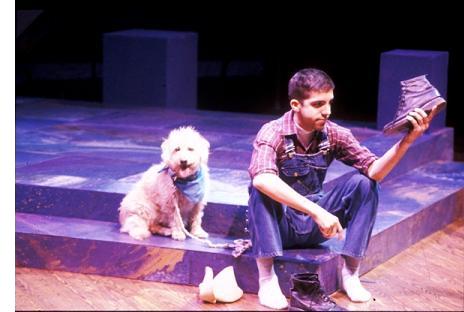
Norman Wilkinson, who passed at age 81 on December 23rd, was one of my theatre professors at UMaine. In addition to making me read (well, okay, skim) dozens of plays for his Masterpieces of World Drama and Theatre History classes, thereby expanding my theatrical vocabulary and introducing me to the works of Pinter, he also cast me in every show he directed in my four years there. Of Mice And Men was the first show I did in college, and when I saw my name on the cast list on his office door it was a profound moment of validation for me. I was so very insecure at the time, coming from a high school program that - except for my Freshman year, about which I've blogged extensively - was entirely unfulfilling, and I wasn't sure that I'd made the right decision in majoring in theatre. I knew I loved doing this, but wasn't confident that I could. This was a sign that I could indeed.

It might be a stretch to say that Norman was universally adored by the student body. His tastes were usually toward early 20th-century chestnuts (in addition to Mice, he also did Our Town - my first of five, The Little Foxes, and the year after I left, The Man Who Came To Dinner) that nearly always had far more roles for men in a department with far more female theatre majors. He was also a very old-school director: he came in on the first day and dictated the blocking. The self-styled 'elite' acting students shied away from his shows in favor of the more method-flavored approach of Sandra Hardy or the avant-garde flourishes of Tom Mikotowicz. As a teacher, I doubt he varied his approach significantly in 35 years, and probably used the same mimeographed material from the early '70s. There were even rumors of inappropriate suggestions toward some female students - this didn't seem to jive with the Norman I knew. Maybe he had a different side that I never experienced, or it's conceivable that an innocently flirty but chauvinistic remark had been misinterpreted. In any case, when the female drama students organized a protest against sexism in the theatre department, Norman was one of their principal targets.

Even granted his faults - real, alleged, or otherwise - I knew Norman as a kindhearted, learned, soft-spoken man. When we corresponded a few years after his retirement in the mid-90's he seemed touched and grateful to be remembered by a former student; I couldn't help but feel sorry for him. His obituary hinted that in his final years he suffered from Alzheimers, which struck me as a cruel, bitter irony. (As it turns out, it's his wife that suffers from Alzheimers, not him.)

My favorite theatre experience at UMaine was also the most mold-breaking production Norman had attempted. We did Terra Nova, the story of Captain Scott's tragic Antarctic expedition - a startlingly visual and theatrical piece that worked against Norman's tendency toward hidebound tradition. Only one female character, alas, but nonetheless it was one of the most cohesive pieces he did. He also gave me my best role at UMaine, Evans the doomed Welshman. My death scene is still a conversation piece at my grandparents' house two decades later. It was also one of the tightest ensemble I'd experienced; we were all working together in one of the most positive experiences I've had as an actor, and we dubbed our director "Captain Normie." It was also a treat to see Norman with his hair down, so to speak, at the cast party at his home. After a few drinks, he was seated at the piano belting out some old songs and laughing loudly and joyfully.  That's how I'll choose to remember him.

Bruce Allen (left)
Bruce Allen was a lovely, lovely man with a gentle demeanor and a dry Maine wit. He was a freelance writer and literary critic and former English professor who turned to acting in his 50's, perhaps inspired by his own daughter Susan with whom I'd worked in high school, UMaine, and locally afterwards - she was the Mother Superior in that seminal Agnes. Bruce started a murder mystery dinner troupe, Without A Clue, and was a producer with Theatre on the Rocks, helping them grow from a small community group to one of the stalwart groups performing at the Players Ring. He also was very active with Generic Theater and Senior Moments.

Bruce played my father in two shows: my first post-college show (Doc Gibbs to my George in Our Town #2), and later in GT's The Substance of Fire. He gave me my first paying acting job (all $50 worth) with Without A Clue. He granted me opportunities to direct with Theatre on the Rocks, perhaps before I deserved them.

It was always a treat to work with Bruce. Whatever limitations of range or mobility he may have had, he always brought a positive work effort and no ego, always tested his limits, and almost always transcended them. He was my Dr Windsor in Woman In Mind and my Tobias in A Delicate Balance. As producer, he was my staunch supporter in The House of Blue Leaves and A Lie of the Mind. Last year he even gave my Zombie parody of Our Town a reading with GT's playreading series.

What impressed me most about Bruce over the 18 years that I knew him was his amazing resilience. He bore numerous physical ailments throughout his life with no complaint. He always walked with a cane due to a childhood bone disease. He broke three ribs two days before he opened Our Town #3 as the Stage Manager, and still went on. He was struck by a mystery ailment in the middle of a performance of Woman In Mind (and was replaced by my stage manager), but was back and in prime condition for the next show. He was out of action for a few years due to a viral infection that attacked his equilibrium, but got himself back onstage. Even battling cancer over the past year, he still soldiered through his treatments and was preparing to organize some more GT readings before his heart gave out on December 16th, age 74.

Guarav's photo in a shrine near where he was found.
And then there's Gaurav Gopalan. Taken from us too soon, far too young (only 35), and by a senseless - and thus far anonymous - act of violence during the early morning hours of September 10th. As a testament to the amazing diversity of the Washington DC theatre community, he was one of two PhD rocket scientists active in area theatre.

Radiating with passion and intelligence and joy, Gaurav was almost intimidatingly unforgettable presence. He worked with Scena Theatre and Studio Theatre, was a Helen Hayes judge, knew everything knowable about Shakespeare and his plays (and could go on for over an hour connecting Shakespeare and astrophysics). He made his mark working with Washington Shakespeare Company (now WSC Avant Bard) for a number of years, assembling extraordinarily ambitious staged readings of Bingo, The Romans In Britain, and several others. The closest I ever got to working for Joy Zinnoman was performing in the scenes he prepared for her famous directing classes, doing The Cryptogram and Uncle Vanya. When times were tough, he even spotted me the day's pay I lost when I spent an afternoon rehearsing with him - it was generally accepted that G came from a very well-off family, and he was frequently generous. When he co-directed The Cherry Orchard with WSC, he bought the entire company tickets to see The Seagull on Broadway - he loved Chekhov almost as much as Shakespeare.

He also went out of his way to make me feel that I was special and talented. Sometimes he saw things in me that I didn't see. He cast me as Gaev (a character well above my age range) in Cherry Orchard because he apparently saw aspects of him in me, and trusted that the age difference would sort itself out in the end. If Gaurav was indeed bipolar, when he was on a high, it was definitely an experience. And our Cherry Orchard was certainly Gaurav on a high. Call it what you will, that was certainly a unique experience.

He dropped off the radar for a while afterwards when he apparently hit the lows that followed his highs. He resurfaced more Gaurav than ever, working with Constellation Theatre's epic Ramayana, and later rebranding himself in glorious makeup as Gigi (his initials... get it?). It was in the process of this rebirth that he was so brutally taken.

My fondest memory was a party he held at he and his partner's palatial house in Columbia Heights. A group of friends, of which I was honored to be included, gathered for drinks, food, and Shakespeare readings.  I read Sonnet #20 as well as Antony's famous speech from Julius Caesar. He was effusive as ever with his praise.

Around the same time - down to the hour - that his body was receiving funeral rites by his grieving family in Katmandu, he appeared in my dream and gave me one of the world's greatest hugs, and told me once again how talented I was. Maybe it was coincidental - his death weighed heavily in my thoughts - but I prefer to think that he dropped by on his way to the afterlife to bid me a loving farewell. I'm grateful beyond words that he was so thoughtful. It helped me work through the numerous emotions I dealt with in the aftermath, anger being chief among them.

Norman, Bruce and Gaurav, thank you so very much for everything. You meant more to me than you know.